Urgent Capability Improvements: Maximising gains with stretched defence budgets
The security environment is becoming more complex, shaped by the rapid emergence of uncrewed and AI-enabled systems. Governments are working to harness these technologies while managing the risks they introduce.
In the UK, the Strategic Defence Review and Defence Investment Plan have set a clear direction of travel, stating that the Army must increase its effectiveness tenfold over the next decade.
The publication of the Defence Investment Plan provides greater clarity on funding priorities, but it also reinforces the need for disciplined choices. With defence budgets under increasing scrutiny, delivering measurable improvements in capability has become as important as investing in long-term transformation.
In this context, it is more important than ever that defence spending is targeted, pragmatic, and aligned to operational need. In this article, we set out the case for Urgent Capability Improvements (UCIs), which are focused, cost-effective interventions that draw on the UK’s innovation ecosystem to deliver meaningful gains, in the near term.
The now, the future, and the gap in between
Realising the Army’s ambition depends not only on new capabilities but also on improving existing capabilities. Many existing capabilities remain slow, burdensome to personnel, and cannot easily be sped up due to safety concerns. Making these processes faster, easier, and safer is critical to increasing effectiveness.
For example, if soldiers need to move through an area suspected of containing explosive ordnance or contaminated by chemical, biological, or radiological agents, dedicated Explosive Ordnance Disposal (EOD) or Counter Chemical-Biological-Radiological-Nuclear (C-CBRN) teams must carry out detailed clearance activities before forces can proceed. These activities are necessarily cautious and time-consuming, which means they present critical bottlenecks.
Transformational solutions such as autonomous systems or advanced sensing platforms offer the potential to address these constraints. However, they often require significant investment, longer development timelines, and carry technical uncertainty.
In practice, this makes it unlikely that such solutions alone will deliver the required operational gains within the required timeframes.
UCIs help bridge this gap. They focus on practical, near term improvements that make existing processes quicker and more reliable to carry out.
Bridging the bottleneck
A strategy to bridge the gap between the ‘Now’ situation (slow and burdensome) and the ‘Future’ vision (ambitious and expensive), enables a targeted, pragmatic approach to delivering solutions quickly, simply, and cost-effectively.

A structured approach to UCIs requires a clear and repeatable methodology. Here’s an example of a UCI driven by DSTL.
Case Study of effective Urgent Capability Improvement driven by DSTL: RAPIDS
Sagentia Defence has developed RAPIDS (Recovery and Preservation In Dangerous Sampling), which illustrates how targeted innovations can significantly improve capabilities.
Challenge: C-CBRN soldiers are required to collect samples of unknown chemicals and biologicals for field testing and transportation back to labs for further analysis. Depending on the location and logistics around the sample collection, the substance may need to be preserved for weeks, not just hours or days. These activities are inherently hazardous and operationally critical, as highlighted by incidents such as the Salisbury Nerve Agent Attack.
Current approach (Now):
C-CBRN soldiers, wearing multiple layers of personal protective equipment (PPE), use cotton swabs and pots to gather samples. The layers of PPE reduce dexterity, making the process slow, physically and mentally demanding, and prone to error.
The Future:
The ideal solution may be robotic sampling systems, removing personnel to a safe location and negating fidelity and PPE issues. While these solutions are in development (e.g., Oxford Dynamics’ Strider), the technology has hurdles to overcome, will be expensive, and will take time to develop, test and deploy. It is unlikely that robotics will replace human CBRN sampling in the near term, nor will they become the complete solution for sampling.
The solution that bridges the gap:
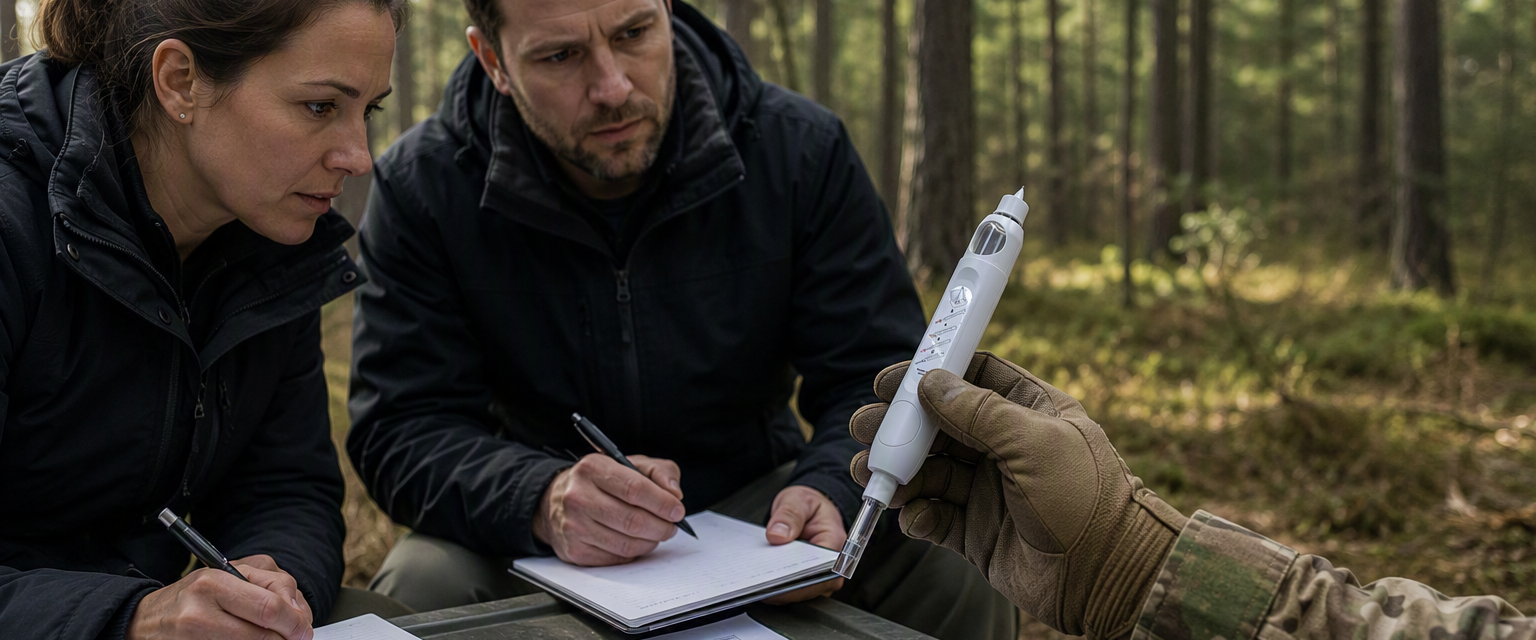
RAPIDS is a swabbing and sample collection device specifically designed to be easy to use in full PPE. The system simplifies the sample collection workflow, improves chain-of-custody, and supports safer downstream laboratory handling for analysis.
By combining usability engineering with materials science and operational insight, RAPIDS shows how targeted interventions can improve both efficiency and safety in critical tasks and address bottlenecks.
A structured approach to Urgent Capability Improvement
1. Identify the bottleneck
The critical first step is to identify the tasks that are slow, difficult, and dangerous. The people who are best placed to provide this insight are the frontline personnel who conduct operations. Speaking to frontline personnel will quickly reveal the tasks that they find difficult, and the equipment that needs optimising or improving. Frontline personnel are also heavily pragmatic, which enables them to provide great insight into short-term improvements. While the preference may be a swabbing robot, there is more likely to be a request for a better swab.
The most effective approach is to allow usability engineers and concepting experts to observe operators interacting with equipment. These experts are trained to identify pain points and difficulties, which are further backed up by discussing these issues with the operators to identify the underlying technical bottlenecks.
2. Concept generation and refinement
With bottlenecks identified, concepting engineers can rapidly design potential solutions. It is imperative that this concepting activity draws on a wide range of experience. Many problems in defence can gain learnings from other sectors, for example RAPIDS draws heavily on Sagentia Medical’s experience in medical sample collection.
The best-case solution to a bottleneck is an existingthat can be brought in immediately, often from another industry. Other situations may only require slight modifications or adaptations to existing equipment. It is also important, however, that those performing the concepting do not have a vested interest in a particular solution, otherwise you may find that the proposed solution happens to be a modification of the concepting team’s existing product line.
Only if there are no more cost-effective routes available should a new device or product be developed. In any case, as part of the concepting phase, the time and cost to develop the solution must be estimated and clearly justified by proposed operational improvements.
Once concepts are generated, these should be reviewed by end-users. Operators can provide extremely valuable feedback on the practicality and appropriateness of proposed solutions, allowing concepts to be quickly refined and down-selected.
3. Rapid development
The first step in developing any UCI is to create a streamlined prototype that allows quantification of operational improvements, either through efficiency, cost or safety. This prototype should be developed in a number of weeks. If it requires more than this, then the concept is more likely a next-gen piece of equipment than a UCI.
Once value has been demonstrated, funding for development needs to be made available. In most cases, UCIs will not be valuable new product lines for industry, but rather short-run specialised sub-systems. UCIs are not about stimulating industry to make new products; they are about leveraging industry expertise to solve problems, and so need to be fully funded by the MOD.
The developments that follow need to be conducted in close contact with end-users to maintain alignment throughout. It is key that UCIs are focused and do not grow into major developments that aim to fix too many problems at once. UCI developments must aim to get prototypes onto exercise as soon as possible, and as soon as systems are showing the desired operational advantages, development must move from iteration into manufacture.
Collaboration can be an effective means of achieving speed when employed correctly. There are rich ecosystems of innovation expertise, domain expertise, and manufacturing expertise in the UK that can be brought together to unlock UCIs.
Urgent Capability Improvements aim to reproduce the model of programmes like RAPIDS across defence.
How Sagentia Defence can help
Sagentia Defence, alongside its sister Sagentia practices, has 40 years of experience in developing technologies for our clients. Our “” philosophies place usability, commercial viability, and technical feasibility at the heart of our work.
Our concept generation and development work leverages our operational analysts, usability engineers, applied scientists, mechanical/electronic/software engineers, and manufacturing experts. Our speed can be seen in our response during COVID-19 where we developed a novel ventilator from scratch to full regulatory approval in under 8 weeks.
We draw on cross-sector expertise, and are not aligned to specific products or solutions, allowing us to propose the best solution to a problem, whether that be a commercial-off-the-shelf (COTS) system from the agricultural industry, or a rapid bespoke development leveraging our experience in consumer electronics.
What Defence Organisations Need to Know About Urgent Capability Improvements
1. What are Urgent Capability Improvements (UCIs) in defence?
Urgent Capability Improvements (UCIs) are targeted interventions designed to improve existing military capabilities quickly and cost-effectively. Rather than relying solely on long-term transformational programmes, UCIs focus on reducing operational bottlenecks, improving usability, and increasing efficiency, safety, or effectiveness using proven technologies and engineering expertise.
2. How can industry help deliver the ambitions set out in the Strategic Defence Review?
Industry can support Strategic Defence Review objectives by applying engineering, scientific and usability expertise to improve existing capabilities alongside developing future systems. Drawing on proven technologies, commercial solutions and cross-sector innovation can accelerate delivery while reducing technical risk and development costs.
3. How can MOD and industry collaborate more effectively on capability development?
Successful collaboration starts with a shared understanding of operational challenges. Early engagement between frontline users, defence stakeholders and industry specialists enables problems to be defined clearly, solutions to be assessed objectively, and developments to remain focused on delivering measurable operational outcomes.
4. How can MOD defence innovation programmes achieve greater value for money?
Value for money is achieved when investment is aligned to operational outcomes. This often means prioritising solutions that can be deployed rapidly, adapting existing technologies where possible, and drawing on expertise from sectors outside defence before committing to expensive bespoke developments.
5. What role do Urgent Capability Improvements play within the UK’s Defence Investment Plan?
UCIs complement strategic investment programmes by providing a mechanism for delivering near-term operational benefits. They help ensure resources are directed towards practical improvements that address frontline needs while supporting longer-term transformation objectives.
6. What qualities should defence organisations look for in innovation partners?
Effective innovation partners combine technical expertise with a strong understanding of operational contexts. They should be capable of identifying practical solutions, drawing on experience from multiple sectors, and recommending the most appropriate approach rather than promoting specific products or technologies.
7. How can defence leaders balance immediate operational needs with future capability investment?
An effective portfolio balances short-term capability enhancements with long-term transformational programmes. Investing across both horizons helps maintain operational readiness today while developing the advanced capabilities required for future conflicts.
Defence markets
Discover more about our collaborations across the defence market to navigate challenges around capability, decision making and technology
Defence services
Find out about Sagentia Defence’s comprehensive suite of services, tailored to support the defence sector as a trusted partner
Contact us
Would you like to talk to our team about your challenges in defence? Complete our form and we’ll be in touch soon