Air fryers become embedded in UK cooking routines, consumer research shows
August 3, 2026
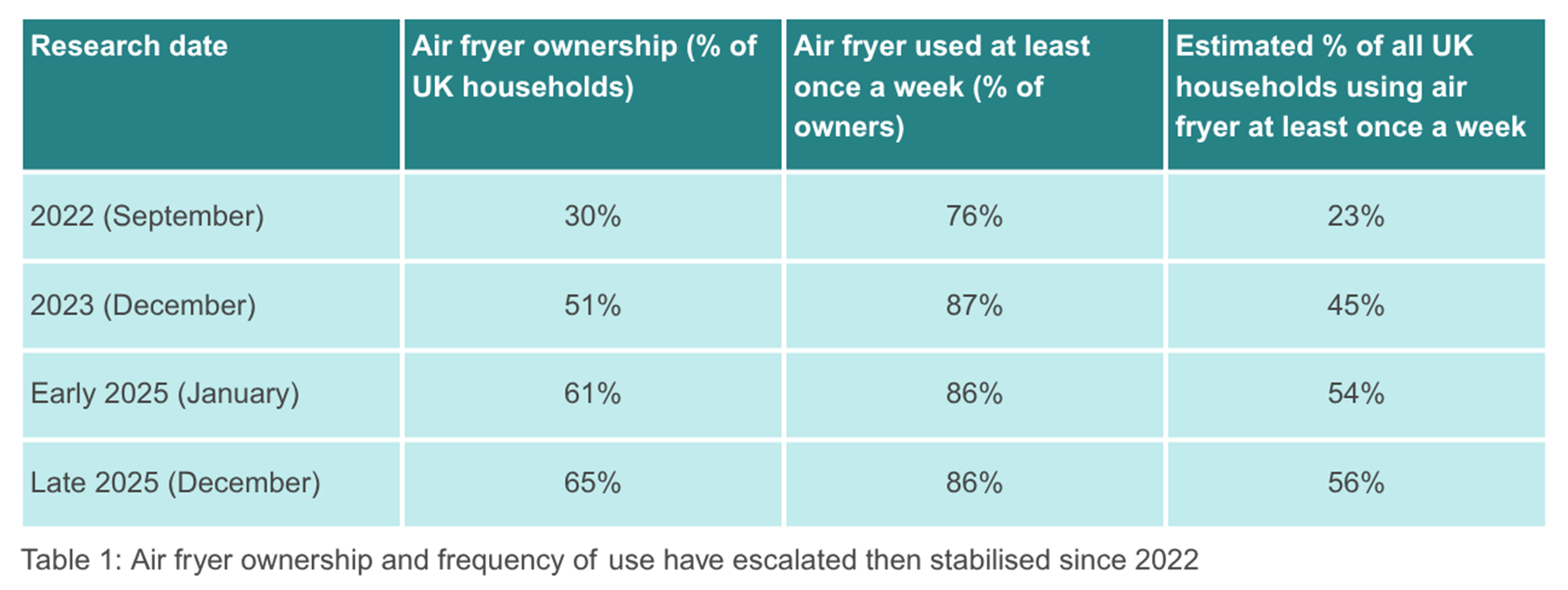
Leatherhead Food Research has tracked consumer air fryer behaviour since 2022. The latest data shows that 65% of UK households now own an air fryer, with the majority of owners (86%) using it at least once a week, raising important considerations for food manufacturers and retailers.
UK air fryer ownership more than doubled between 2022 and 2025, rising from 30% to 65% of all UK households. Over the same period, use intensified and has stabilised at high levels: 86% of owners now cook with their air fryer weekly or more frequently. This equates to an estimated 56% of all UK households cooking with an air fryer at least once a week (see Table 1).
So, how and why do people use air fryers? And what does this mean for food manufacturers and retailers?
Frozen and chilled categories dominate air fryer use
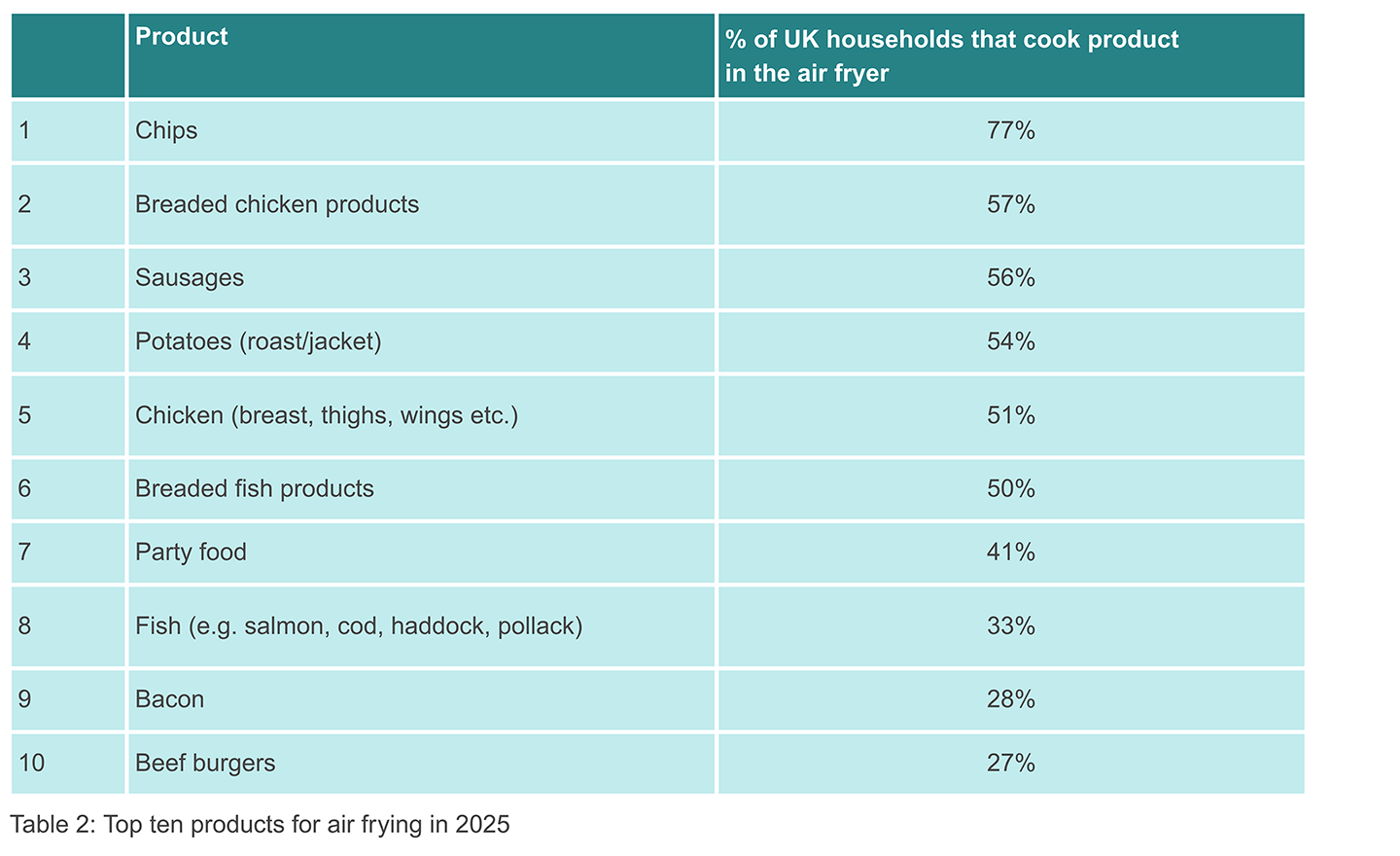
Our 2025 consumer survey shows that chips continue to top the air fryer cooking chart. However, more than half of owners use them for frozen and chilled products such as breaded chicken (57%) and sausages (56%). Breaded fish products (50%) and party foods (41%) are also popular choices for air fryer cooking.
Table 2 shows our latest data on the top ten products for air fryer cooking. For many of these products, texture is a big part of the overall sensory experience. Consumers expect crunchiness, crispiness, succulence – or even a combination of textures.
Quicker, more cost-efficient cooking is a consumer goal
Speed and cost-efficiency have consistently been the biggest drivers of air fryer use since we started tracking consumer behaviours in 2022. The latest figures show that 64% of owners purchased an air fryer to cook meals more quickly, while 60% cited lower running costs compared to a conventional oven.
These motivations are likely to shape what consumers expect from products they cook in the air fryer.
It’s also worth noting that 70% of owners say they typically use their air fryer to cook for one or two people. However, with 28% saying they cook for three or more, use of the appliance is not limited to single-portions or snacks; it’s also used for larger household meal preparation.

Consumer behaviour in the absence of air fryer guidance
Our findings show that around a third (31%) of owners struggle to know how long to cook certain foods in an air fryer. 44% also indicate that on-pack air fryer cooking instructions may influence purchasing decisions.
However, the absence of instructions doesn’t necessarily mean consumers avoid a product. Instead, they adapt. More than a third (35%) say they mainly guess cooking times, while others use online searches (26%), appliance manuals (18%) or informal ratios to adjust the cooking instructions for conventional ovens.
Together, these figures suggest that clear, product-specific air fryer cooking instructions could increase consumer confidence as well as supporting consistent outcomes.
Implications for food manufacturers and retailers
Air fryers are firmly established as a mainstream appliance in UK households and are becoming embedded in consumer cooking routines. Chips, breaded chicken and sausages dominate use. However, use is also widespread across other categories that benefit from the appliances’ speed and crisping capabilities (e.g. breaded fish and party food).
Now that air fryer use has stabilised at high levels, manufacturers and retailers may wish to consider dedicated on-pack cooking instructions for more chilled and frozen products. The top ten products for air frying would be a good place to start.

“Air fryers circulate hot air very quickly in a cooking space that is much smaller than conventional ovens. This enables shorter cook times, but it can also result in faster surface browning and greater sensitivity to product size or volume. That’s why science-led cooking trials are so important.”
Natasha Burton, Head of Cooking Instructions, Leatherhead Food Research
How Leatherhead Food Research can help
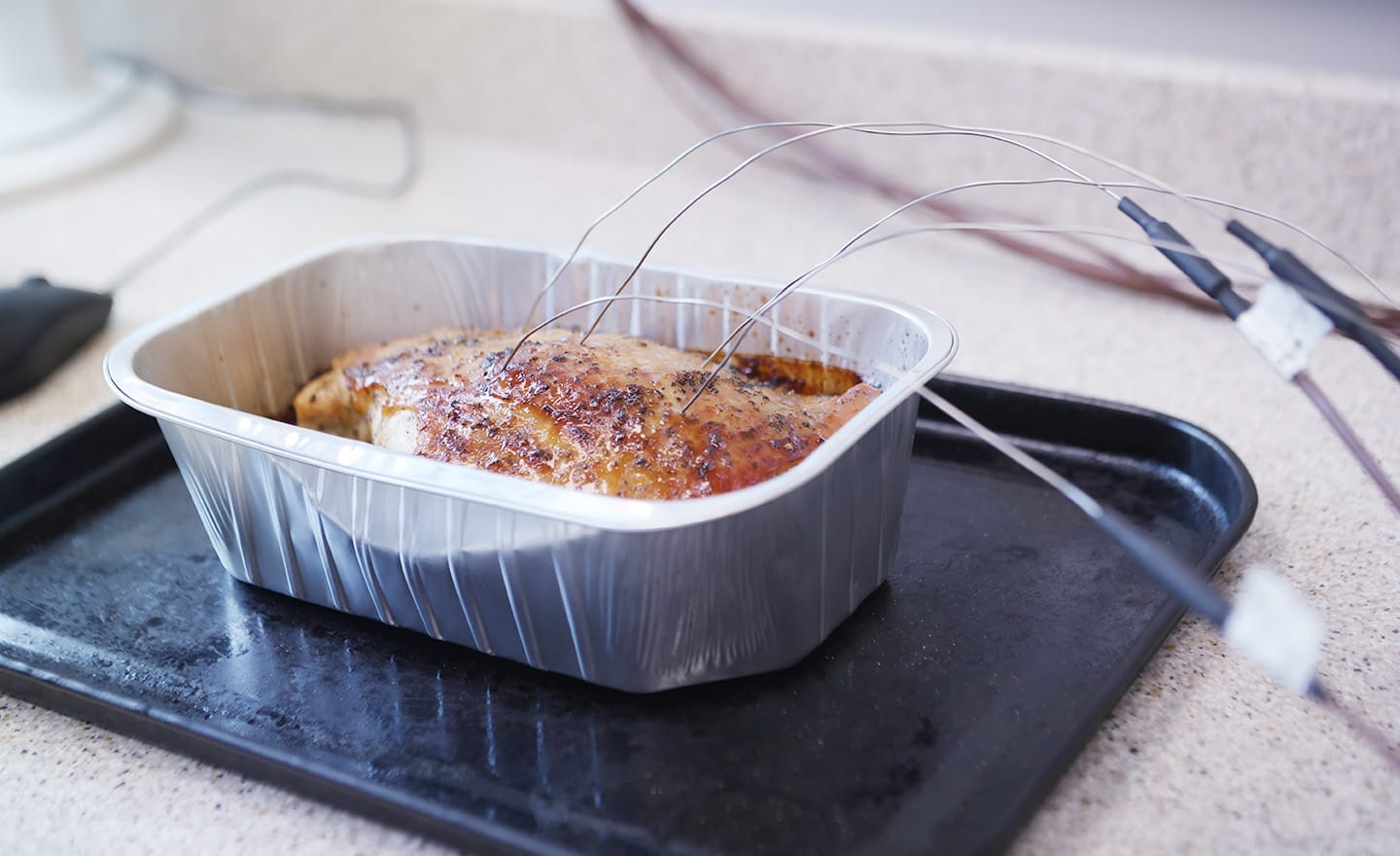
Our expert food technicians have carried out more than 9,000 air fryer cooking instructions trials. We can determine whether a product is compatible with air fryer cooking and, if so, devise simple and effective on-pack instructions.
Various cook times and temperatures are trialed until we land on the perfect combination as well as any additional steps such as shaking, stirring, or turning the product as it cooks. Then we verify and validate the process, repeating multiple tests across various air fryer models with different wattage or capacity to ensure the instructions consistently deliver a safe, ready-to-eat product. We also consider other factors that matter to consumers – from speed of cooking to the overall sensory experience.
Our lab-based tests verify that products reach food-safe time-and-temperature combinations approved by retailers.
Cooking trials are carried out in our UKAS accredited testing laboratory (no. 9365) for cooking instructions testing (air fryer, gas and electric thermal oven, electric fan oven, gas and electric hob, microwave oven, gas and electric grill, deep fat fryer, defrost).
All research cited was conducted online on behalf of Leatherhead Food Research. The figures have been weighted and are representative of all UK adults (aged 18+). Unless otherwise stated, figures used in this report are from the December 2025 survey.
Late 2025 figures: Total sample size 2,074 adults. Fieldwork undertaken between 19-22 December 2025.
Early 2025 figures: Total sample size 2,057 adults. Fieldwork undertaken between 6-7 January 2025.
2023 figures: Total sample size 2,054 adults. Fieldwork undertaken between 20-21 December 2023.
2022 figures: Total sample size 2,063 adults. Fieldwork undertaken between 16-19 September 2022.