What does this mean for industry?
The proposed restriction does not clarify what will happen to existing authorisations under REACH. The expectation is that Cr(VI) substances will be delisted from Annex XIV, so authorisations will no longer apply. However, this and any transition arrangements will have to be elaborated separately by the Commission.
Given the Commission’s intention to shift Cr(VI) substances from the authorisation to the restriction regime, when the restriction comes into effect it will no longer be possible to apply for authorisation to continue using Cr(VI) substances. Decisions to refuse upstream chromium applications for authorisation are expected to coincide with introduction of the restriction. Businesses will need to show that they meet the conditions of the restriction, or cease using Cr(VI) substances. Obligations will shift and companies need to plan for compliance and business continuity accordingly.
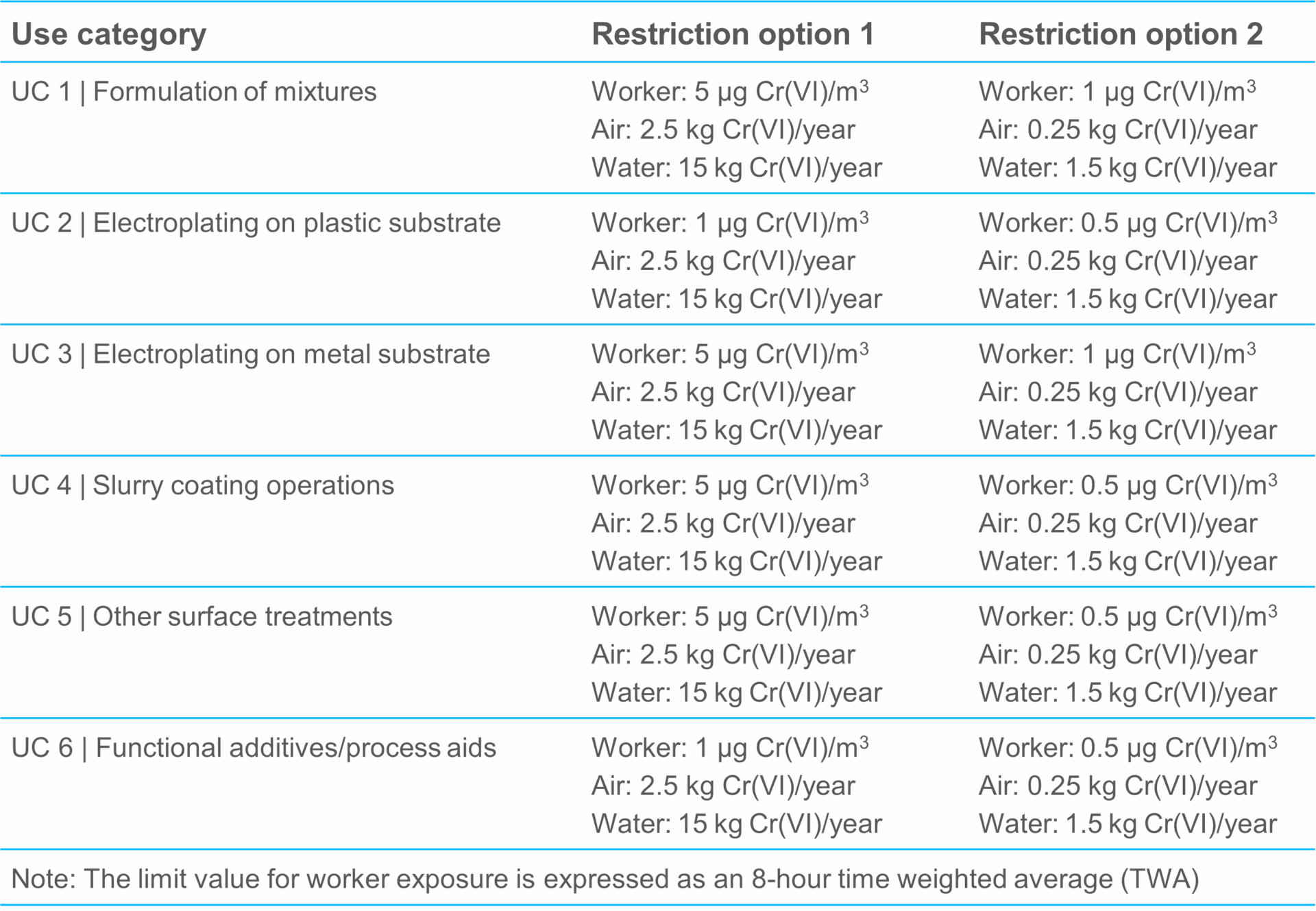
Worker and environmental exposure will need to meet the exposure and emissions limit values. Enforcement authorities will expect to rapidly check businesses can demonstrate compliance based on good monitoring data and records. Unlike certain other restriction entries in REACH, the proposed wording of the Cr(VI) restriction does not state which monitoring methodologies must be used for occupational exposure or environmental emissions. CARACAL will have an important role in terms of clarifying expectations for monitoring methodologies to ensure a level playing field across the EU.
The more stringent options will be more difficult for, and require greater investment by, companies wishing to continue using Cr(VI) substances in the EU. Companies will need to assess what changes are needed to comply under either option. In particular, the environmental emissions limit values could prove challenging to meet for higher volume users of Cr(VI) substances, whatever restriction option is chosen.
What’s next?
Stakeholders will be invited to provide their feedback on the proposals during a six-month consultation starting on 18 June 2025.
Following the consultation, ECHA’s scientific committees (the RAC and SEAC) will evaluate the proposal, considering the evidence received. The final decision on the restriction and its conditions will be made by the European Commission and EU Member States, based on ECHA’s proposal and the committees’ opinions.
How Sagentia Regulatory can help
If you think you will be affected by the proposals, contact us! We can help you:
- Make your voice heard as public authorities progress these proposals to restrict the use of Cr(VI) substances by replying to the forthcoming public consultation to provide the best possible chance of influencing the thinking of key decision makers
- Assess the implications for your business and develop a practical strategy and roadmap that minimises business risks but also captures opportunity
If you’d like to speak with our team, please get in touch at [email protected].