
SETAC Europe 2026
Posters and leaflets
SETAC Europe 36th Annual Meeting | May 17-21, 2026
Our SETAC Europe 2026 posters focus on how updates in guidance and methodology are influencing regulatory risk assessment in practice. Covering emission scenarios, endocrine disruptor evaluation, and bee risk assessment, they highlight where changes in approach may affect both data interpretation and assessment outcomes.
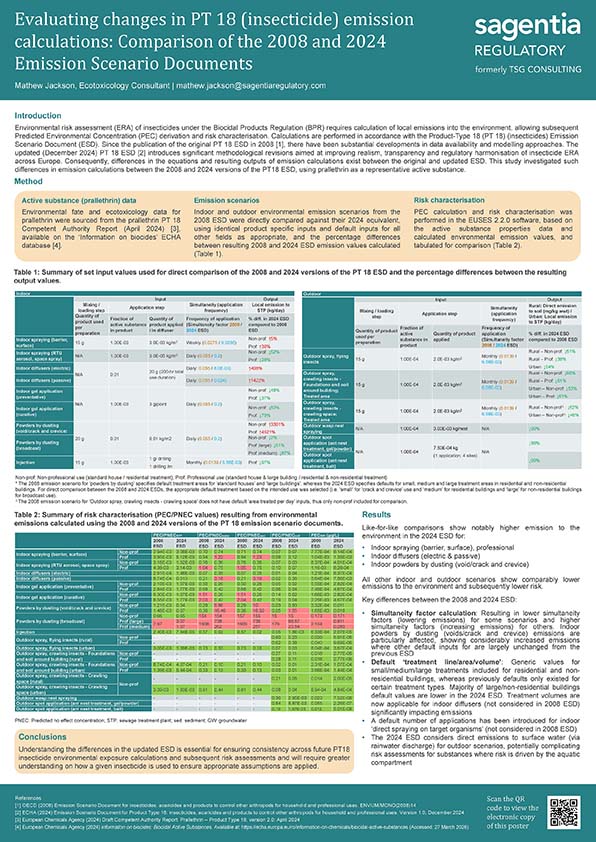
Evaluating changes in PT 18 (insecticide) emission calculations: Comparison of the 2008 and 2024 Emission Scenario Documents
Mathew Jackson, Ecotoxicology Consultant | [email protected]
Environmental risk assessment (ERA) of insecticides under the Biocidal Products Regulation (BPR) requires calculation of local emissions into the environment, allowing subsequent Predicted Environmental Concentration (PEC) derivation and risk characterisation. Such calculations are performed in accordance with assumptions and equations presented within the Product-Type 18 (PT 18) (insecticides) Emission Scenario Document (ESD). Since the publication of the original PT 18 ESD in 2008, there have been substantial developments in data availability and modelling approaches. The updated (December 2024) PT 18 ESD introduces significant methodological revisions aimed at improving realism, transparency and regulatory harmonisation of insecticide ERA across Europe. Consequently, differences in the equations and resulting outputs of emission calculations exist between the original and updated ESD. This study investigated such differences in emission calculations between the 2008 and 2024 versions of the PT18 ESD, using prallethrin as a representative active substance. Indoor and outdoor 2008 emission scenarios were directly compared against their equivalent 2024 scenario, using identical insecticide product specific inputs and default inputs for all other fields as appropriate (as relevant for the original and updated ESDs, accordingly). Results of these direct comparisons showed that in numerous instances, when comparing like-for-like, calculated emissions are considerably higher for indoor scenarios when based on the updated ESD. In contrast, like-for-like comparison of outdoor scenarios show lower indirect (via wastewater for urban product uses) and direct soil (for rural product uses) emissions based on the updated ESD. However, it is noted that the updated ESD now also considers direct emissions to surface water (via rainwater discharge) for outdoor scenarios, which may potentially complicate risk assessments. Equation parameters which have undergone notable changes within the updated ESD include ‘simultaneity factor’ derivation and default ‘line/area/volume treated with the product’. Understanding these differences is essential for ensuring consistency across future PT18 insecticide environmental exposure and risk assessments.
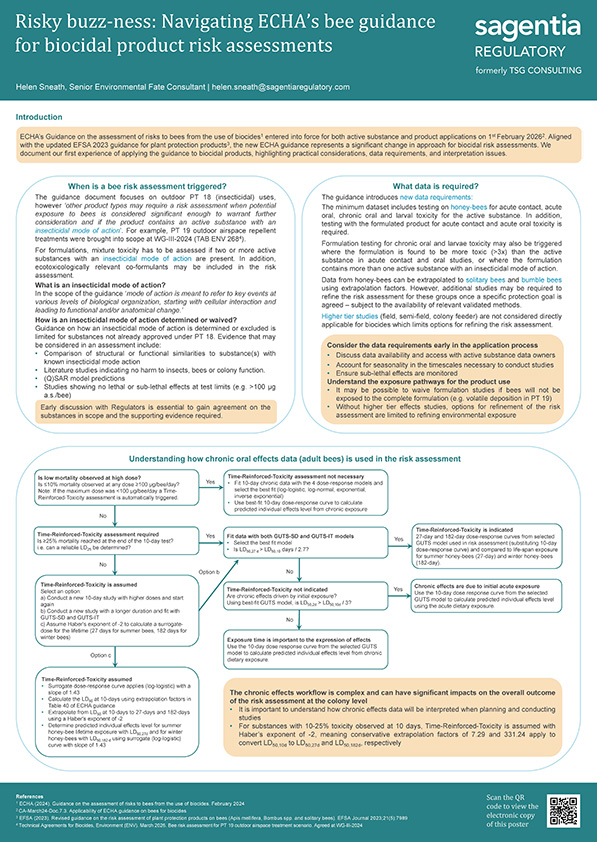
Risky buzz-ness: Navigating ECHA’s bee guidance for biocidal product risk assessments
Helen Sneath, Senior Environmental Fate Consultant | [email protected]
ECHAs Guidance on the assessment of risks to bees from the use of biocides entered into force for both active substance and product applications on 1st February 2026. Aligned with the EFSA guidance for plant protection products, the new ECHA guidance represents a significant change in approach for biocidal risk assessments. We document our first experience of applying the guidance to biocidal products, highlighting practical considerations, data requirements, and interpretation issues. Lessons learned provide valuable perspectives for stakeholders preparing to navigate bee risk assessments for biocidal product authorisations.
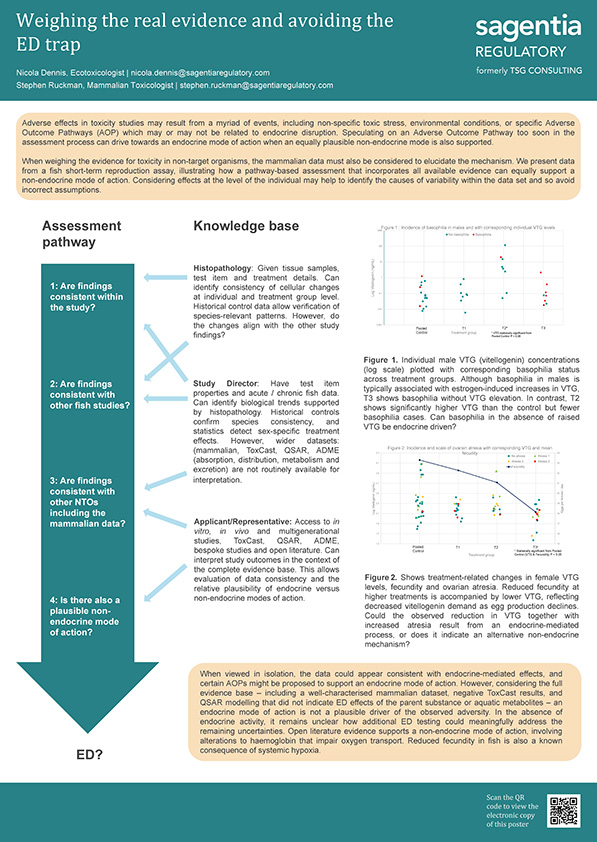
Weighing the real evidence and avoiding the ED trap
Nicola Dennis, Ecotoxicologist | [email protected]
Stephen Ruckman, Mammalian Toxicologist | [email protected]
Since 2018, it has been a requirement for active substance renewal and new active substance registration to provide an assessment on the endocrine disrupting properties of a pesticide in accordance with EFSA / ECHA Guidance for the identification of endocrine disruptors in the context of Regulations (EU) No 528/2012 and (EC) No 1107 / 2009. In a bid to harmonise assessments for endocrine disruption, an expert meeting was held in November 2024, a report on the outcome of this meeting was published in October 2025 (Recurring issues in mammalian toxicology and ecotoxicology related to endocrine disruptors. EFSA Supporting publication 2025:EN9743). Common challenges in the interpretation of non-target organism data were identified and include:
- High variability and poor reporting of vitellogenin (VTG) a biomarker used to identify EAS (estrogen, androgen and steroidogenesis) activity in fish
- Quality of reporting for histopathological evaluations
- Data limitations leading to a limited weight of evidence and uncertainty
- Limited experience in performing and interpreting Conceptual Framework Level 5 data
We present supportive evidence to open up the discussion on the challenges of interpreting endocrine disruptor data, particularly when faced with identifying a plausible link between adversity and endocrine activity when an alternative non-endocrine mode of action may be the driver. Focussing primarily on the EAS modality, we will discuss how variability in VTG data can lead to uncertainty. Particularly when looking at the influence and relevance of possible outliers. Should effects only be considered at the replicate level even if this seems improbable at the individual level. Can histopathologists reliably opine on the potential for endocrine disruption without sight of the whole dataset. How is uncertainty balanced when looking at the weight of evidence particularly when considering a non-endocrine mode of action. Is there sufficient knowledge within Industry and Regulatory Authorities to critically assess alternative pathways that may be based on years of targeted academic research. How easy is it to move away from the tiered approach of testing under the Conceptual Framework to generate data to answer specific questions.
Download our leaflets

Clearing the path for biological product commercialization
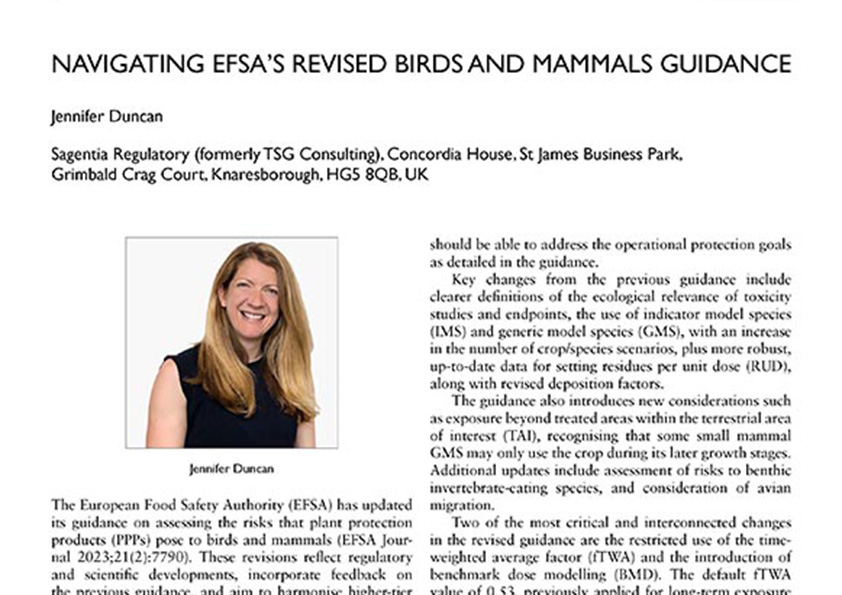
Navigating EFSA’s revised birds and mammals guidance

Product authorisations in Europe

Environmental sciences

Are you ready for REACH?

Biocides – Regulatory affairs
Europe | Plant protection regulatory services
Expert guidance for EU and GB plant protection product compliance
USA | Crop protection regulatory services
Supporting EPA compliance for conventional pesticides and biopesticides
Expert insights
Stay informed with clear, expert updates on evolving regulations